
“Hilda Boswell’s Treasury of Nursery Rhymes” – childhood memories, sensory magic and favourite illustrations from Kate Coldrick in Woodbury.
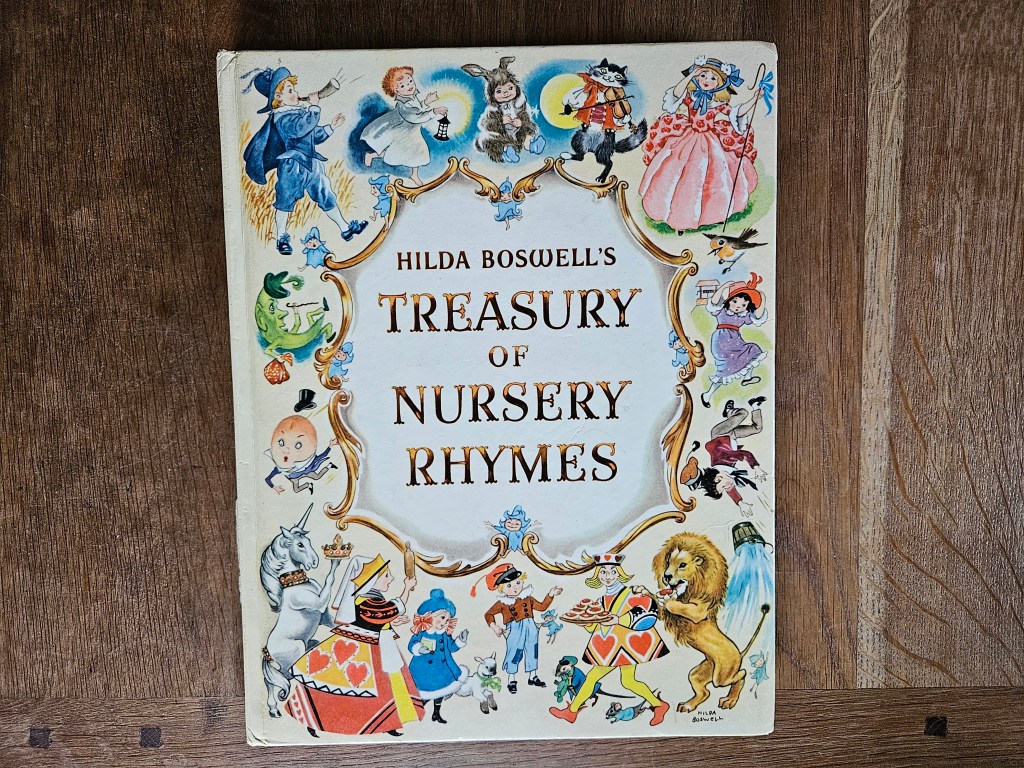
Some books don’t merely sit on our childhood shelves – they carve out a small, permanent room inside us. Hilda Boswell’s Treasury of Nursery Rhymes is one of those books for me. My copy is battered now, its corners softened by decades of handling, but when I open it I’m instantly transported back to being a small child, completely enchanted by the sensory world inside its pages.
Boswell’s illustrations have a very particular kind of magic – delicate, dreamlike, and full of movement. They evoked something in me that I didn’t have language for at the time. Long before I knew anything about autism or sensory perception, I felt these pictures in my fingertips. They were bright but gentle, busy but never overwhelming, and they carried that unmistakable tingle of delight that only certain textures, colours and lines can spark.
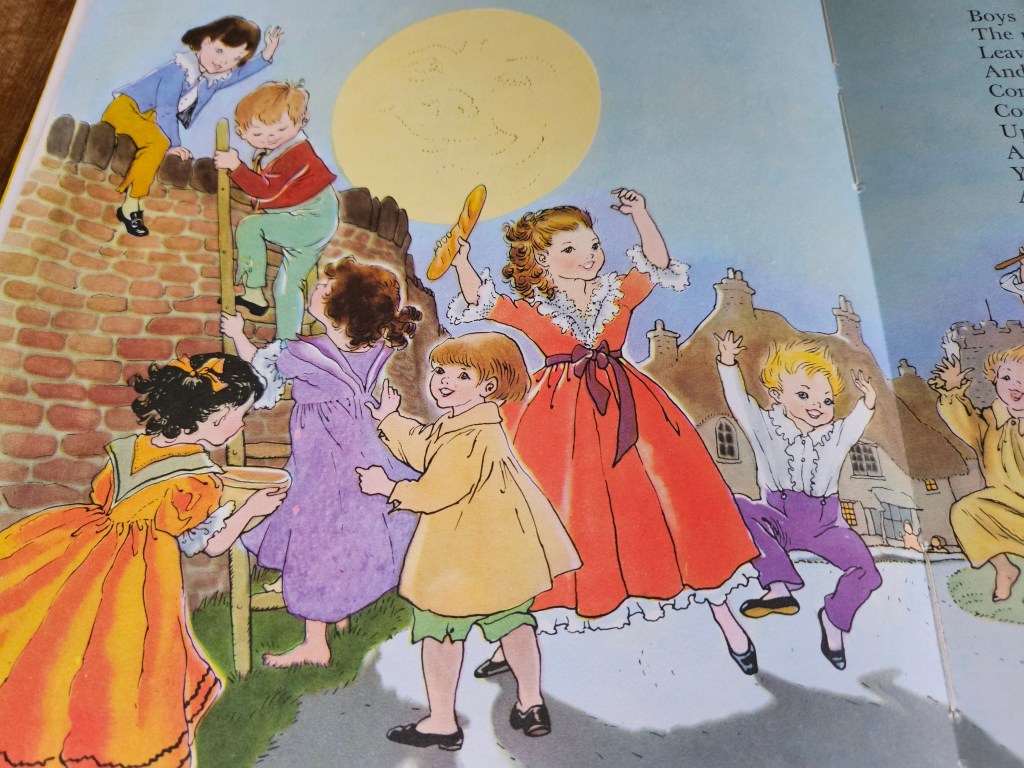
“Boys and girls come out to play” – a page that lived in my imagination

Of all the pages, Boys and girls come out to play was my absolute favourite. In my memory, these illustrations lived in a deep, mysterious shade of purple – a kind of twilight magic that promised adventures after bedtime. It’s funny, seeing them now, to realise that the colours are actually much more balanced and tending toward blue. But my childhood mind clearly tinted them with its own hue. Something in the purple I ‘remember’ must have drawn me in – perhaps that particular wavelength sparked a sensory resonance I couldn’t have articulated then.
What captivated me most was the sense of permission in the scene. Children clambering up walls, running barefoot, clutching spoons, laughing under a benevolent moon – it felt like stepping into a world where rules eased and imagination took over. It has the energy of a midnight feast, the same secretive thrill I later loved in Enid Blyton’s school stories. I wonder now if this was an early clue to the kinds of fictional worlds I’d go on to adore – places where children slip away into their own adventures, unobserved, for just a moment.
Why this book still matters to me
Looking at it as an adult, I realise that Boswell didn’t just illustrate nursery rhymes – she illuminated them. Each page hums with a feeling rather than simply showing an event. There’s warmth, mischief, softness, light. And that emotional layering is what makes this book such a treasure, even now.
It also reminds me how vital illustrations can be for children who experience the world through heightened sensory channels. These pictures didn’t just accompany the verses – they held me. They made the rhymes feel safe, expansive, and alive.
Book details
Hilda Boswell’s Treasury of Nursery Rhymes
Originally published 1960
Illustrations © Hilda Boswell. Used under fair dealing for the purposes of criticism and review.
‘Kate Coldrick’s Book Corner’ is a blog by Kate Coldrick, a literacy tutor and educational writer based in Woodbury, Devon. Each post revisits a much-loved children’s picture book – exploring its illustrations, themes, and the memories it still holds. Find out more about the project on the About Book Corner page.
 Kate Coldrick's Book Corner